
Scientific Interests:
High-energy Astrophysics
Astroparticle Physics
Dark Matter
Particle Physics

Recent Research Highlights:
- Meeting of the CTAO Science Consortium (2025). The CTAO Science Consortium held a meeting in May 12-16 in Garching, Germany. The meeting provided a good opportunity to updated the science prospects for CTAO and to review the status of the construction of CTAO, which has now formally started with the establishment of the CTAO ERIC (European Research Infrastructure Consortium). At the meeting, Rene Ong was honored for serving as CTAO Co-Spokesperson for ten years (2014-2024)
- GAPS Experiment Integrated at NASA Facilities in Preparation for Launch (2024-25). GAPS is a novel balloon experiment designed to search for primary antimatter in the cosmic rays with unprecedented sensitivity. The experiment is funded by NASA in the US, by INFN and ASI in Italy, and by JAXA in Japan. During 2024, GAPS was shipped to NASA's Columbia Scientific Balloon Facility (CSBF, Palestine, TX) and integrated and tested there. It was then dismantled and made the long trip to Antarctica and was re-integrated at the NASA facilities at the McMurdo Station of the National Science Foundation. The current schedule calls for final testing and flight in late 2025.
- CTAO Paper on Prospects for a Survey of the Galactic Plane (2024). The Cherenkov Telescope Array Observatory (CTAO, formally CTA) will carry out a number of Key Science Projects (KSPs), as outlined in the "Science with CTA" book (see below). The intellectual effort for these KSPs will be organized by the CTAO Science Consortium. A very important KSP is the planned survey of the Galactic plane. A detailed paper describes the prospects for this survey, including the expected discovery at very high energies of many more pulsar wind nebulae, supernova remnants and compact binary systems.
- VERITAS Paper on the High-Energy Processes in the Galactic Center Region (2021). A paper summarizing the latest VERITAS results on the VHE gamma-ray emission from the region of the Galactic Center was published. In addition to a strong detection of the gamma-ray source associated with Sgr A*, VERITAS identified a diffuse component of gamma-ray emission along the Galactic Center ridge. This component has an energy spectrum with a hard spectral index, extending up to 40 TeV, providing evidence for a PeVatron accelerator in the Galactic Center region. This work was carried out by UCLA graduate students Matthew Buchovecky and Jamie Ryan.
- Science with CTA Book Published (2019). The book Science with the Cherenkov Telescope Array has been published by World Scientific; the book can be found here .
- Second Workshop on Antideuterons in the Cosmic Rays at UCLA. Antideuterons have never been detected in the cosmic rays, but their presence could have major implications for new physics, including modiels of dark matter and primordial black holes. Rene Ong, Philip von Doetinchem (U. Hawaii), Kerstin Perez (MIT), and Mirko Boezio (INFN-Trieste) organized the second workshop at UCLA in March 2019 to explore the science of antideuterons, both from the theoretical and experimental perspective. The workshop was entitled Antideuteron 2019. The review article summarizing the meeting can be found here.
- The Science with CTA document released. The exciting science program to be carried out by CTA has been put forward in detail in a 200-page document Science with the Cherenkov Telescope Array. This science program was developed over a period of more than five years by hundreds of scientists in the CTA Consortium. The first version of the document was uploaded to the arXiv archive by Rene Ong on 23 September 2017; an revised version was uploaded on January 22, 2018. For more details, see the Press Release on the main CTA web site.
- GAPS balloon experiment approved by NASA . In early 2017, NASA approved funding for the GAPS project to enter the construction phase of the experiment. With funding also available in Japan and Italy, the GAPS team is now working towards the final design and construction of the GAPS science payload. The integration of the payload is scheduled for late 2020 with a first possible science flight during the 2021-2022 Antarctic season. See the GAPS website for more details.
- 2015-2016: Progress on the Cherenkov Telescope Array (CTA). Consisting of two large arrays of atmospheric Cherenkov telescopes, CTA will explore the very high energy (VHE) universe with unprecedented sensitivity. During the last year, the design and development of the baseline observatory made great progress. For an overview of the science of CTA and its current status, see a recent article by Liz Kruesi for Symmetry magazine. An article by Edwin Cartlidge for Science magazine discusses the recent selection of the two proposed locations for the CTA sites.
- Rene Ong elected Co-Spokesperson of the Cherenkov Telescope Array (CTA) Consortium. In September 2014, at a CTA meeting in Catania, Italy, Rene Ong was elected Co-Spokesperson of the CTA Consortium. Consisting of over 1,500 scientists from 150 institutions in 25 countries, the CTA Consortium was formed to design and help construct CTA and to carry out scientific investigations with CTA to explore the VHE universe in the decade of 2020 to 2030. More details on CTA and its science goals can be found at the general CTA public website.
- Update on the Cherenkov Telescope Array. The year 2015 was an important one for CTA with a successful Critical Design Review (CDR) and the selection of the observatory sites. An article by Kelen Tuttle in Symmetry magazine provides a good summary of recent activities and the site selection process.
- 1st Workshop on Antideuterons in the Cosmic Rays. Rene Ong and Philip von Doetinchem (U. Hawaii) organized the 1st workshop dedicated to the science of cosmic ray antideuterons. The workshop was entitled Antideuteron 2014 and was held at UCLA in June 2014.
- Update on the Cherenkov Telescope Array. CTA is a major ground-based gamma-ray telescope project that is under development. CTA plans to construct two large arrays of atmospheric Cherenkov telescopes, one to be installed in the northern hemisphere and one in the southern hemisphere. UCLA is actively working on the site characterization and evaluation studies and is helping to propose two possible sites for the northern array of CTA in Arizona, USA. One proposed site is located 70 km east of Flagstaff, AZ, near Meteor Crater; the other proposed site is located 150 km west of Flagstaff, AZ, on Yavapai Ranch. See the recent article by Elizabeth Gibney in Scientific American that summarizes the present situation. There is also an earlier article on CTA site selection in Science magazine by Nuno Dominguez and a nice article describing the scientific motivation for CTA in Nature magazine by Eugenie Reich.
- Successful flight of the prototype GAPS (pGAPS) balloon experiment (2012). GAPS is a proposed experiment to search for anti-deuterons in the cosmic rays. These particles have never been detected astrophysically but would provide strong evidence for the annihilation of WIMP dark matter. The GAPS team, consisting of ~20 scientists in the US and Japan, designed and constructed a prototype instrument (pGAPS) to verify many of the key design elements of GAPS. After integration in the US, pGAPS was launched in June 2012 by the Japanese space agency (JAXA) from their balloon facility in eastern Hokkaido, Japan. A very successful, six-hour flight followed, as documented on the GAPS website and in a paper written by UCLA postdoc S. Isaac Mognet. The team is now proposing to build the full GAPS instrument for flight from NASA's balloon launch facility at the McMurdo Station in Antarctica.
- VERITAS detects gamma rays above 100 GeV from the Crab Pulsar (2011). The Crab, the remnant from a supernova explosion seen on Earth in 1054, is a famous object in astronomy. Ground-based observatories have detected very high energy (VHE) gamma-ray emission from the Crab for more than two decades, but these (unpulsed) detections were from the Crab Nebula. It has always been a dream to detect VHE emission from the pulsar itself. Based on more than 100 hours of data, VERITAS made the first detection of the Crab Pulsar above 100 GeV. The result, reported in a paper published in Science, indicates a completely new, and unexpected, component of radiation and does not fit within standard pulsar models. The VERITAS detection was highlighted by many science blogs and was the subject of a nice article written by Kim DeRose of the UCLA press office.
- VERITAS discovers VHE gamma rays from the Tycho supernova remnant . The Tycho supernova remnant (SNR) derives from the Type 1a supernova seen on Earth in 1572. As one of only a handful of historical supernovae, Tycho is a very important source in the history of astronomy. The Tycho SNR has been deeply studied and is one of the best understood remnants. Thus, it was always a prime target for observation by northern hemisphere atmospheric Cherenkov telescopes, such as VERITAS. The VERITAS detection came from deep observations made between 2008 and 2010 and are reported in a paper published in Astrophyical Journal Letters. Following the discovery by VERITAS, Tycho was detected at GeV energies by Fermi. Of key importance is that the resulting gamma-ray spectrum from the lowest energies detected by Fermi to the highest energies detected by VERITAS strongly support a cosmic ray (proton) origin for the observed gamma-ray emission.
- Fermi detects gamma rays from the binary source Cygnus X-3. Cygnus X-3 is a rather famous X-ray object that was "discovered" as a soure of TeV and even PeV gamma rays in the 1970's and the 1980's. In fact, these discoveries accelerated the growth of the field of VHE astronomy. In the 1990's and 2000's, Cygnus X-3 was not firmly detected by any gamma-ray telescope, leading to speculation that the original results were statistical fluctations. Now, recent observations by the Large Area Telescope (LAT) of the Fermi Gamma-ray Space Telescope show a clear detection of Cygnus X-3, where the gamma-ray signal is correlated with the 4.8 hour orbital period of the binary system. Contributing to the LAT analysis were two UCLA undergraduates, Nickolas McColl and Laura Marchand, and this work contributed to a paper published in Science.
- VERITAS makes the first detection of gamma rays from a starburst galaxy (M82). This discovery provides important clues towards understanding the origins of cosmic rays. Read the journal article in Nature. Popular articles can be found in Astronomy.com and in the CERN Courier.
- VERITAS discovers VHE gamma rays from a powerful blazar 1ES 0502+675. This source is one of the most distant objects known to emit TeV gamma rays. Since TeV photons are expected to be absorbed by intergalactic radiation fields, this discovery is surprising because it implies that the Universe is more transparent at these energies than expected. Indeed, there are speculations that some sort of new physics may be involved. The discovery was announced in an Astronomical Telegram. Rachel Courtland wrote a nice article in the New Scientist on the possible existence of axion-like particles to explain the observations.
Experimental Program:
Very Energetic Radiation
Imaging Telescope Array System (VERITAS)
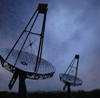
VERITAS is state-of-the-art observatory of very high-energy (VHE) gamma
rays in the energy range between 50 GeV and 50 TeV.
VERITAS consists of four large (12m diameter) reflectors, each viewed
by a camera of 500 photomultiplier tubes (PMTs). Each PMT is read out by a
500 MS/s Flash-ADC. VERITAS has produced many scientific results
so far, including the detection of VHE gamma rays from a
variety of astrophysical sources including pulsar wind nebulae,
supernova remnants, binary systems, active galactic nuclei,
starburst galaxies, and radio galaxies, and very sensitive limits on the annihilation
of WIMP dark matter.
In VERITAS, UCLA has primary responsibility for the
Level 1 Trigger, the Level 3 (multi-Telescope)
Trigger, and the online data storage and archiving facility.
Scientists at UCLA are involved in a broad range of scientic
topics, including Galactic sources, extragalactic sources,
dark matter, and astroparticle physics.
Cherenkov Telescope Array Observatory (CTAO)
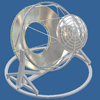
CTAO (previously CTA) is a major gamma-ray observatory that will greatly expand
our understanding of the high-energy and very high-energy universe.
Currently in the construction phase, CTAO will consist of two large arrays of atmospheric
Cherenkov telescopes. One array is under construction in the northern hemisphere in
Spain (La Palma) and the other is under development in the southern hemisphere in
Chile (Paranal).
CTAO is
a logical follow-up to the VERITAS and Fermi missions that are currently
operational.
UCLA has involvement in many aspects of CTAO, including: overall leadership of the project,
development of the Schwarzschild-Couder,
Telescope (SCT), site evaluation and site development, and science planning and simulations.
General AntiParticle Spectrometer
(GAPS) Experiment
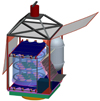
GAPS is a balloon-borne experiment to search for antideuterons in the
cosmic rays. Antideuterons at energies below 1 GeV are a unique signature
of annihilating weakly-interacting dark matter. GAPS will consist of a large
array of Si(Li) detectors surrounded by a time of flight (ToF) detector. A prototype
instrument (pGAPS) was successfully flown in 2012 and funding for the full science
payload was approved by NASA in 2017.
The GAPS team completed the construction of the science instrument in 2023 and it
was subsequently re-integrated and tested throughout 2024.
GAPS has a current schedule to be flown in Antarctica in late 2025.
UCLA is responsible for the time-of-flight system and the overall GAPS trigger.
Fermi Gamma-ray Space
Telescope
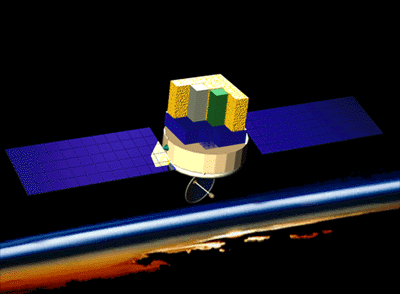
Fermi is a high-energy gamma-ray satellite launched by NASA on
June 11, 2008.
The Large Area Telescope (LAT) on Fermi has an
energy range between 10 MeV and 300 GeV. The LAT consists of silicon strip detectors
for tracking and a CsI calorimeter for energy measurement.
Fermi is fully operational with many exciting results so far and more to come.
Ong has been an Associate Member of the LAT since its inception.
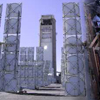
Solar Tower Atmospheric
Cherenkov Effect Experiment (STACEE), Now Completed
STACEE used the atmospheric Cherenkov technique to detect gamma rays
at energies between 50 and 500 GeV. Until recently, this energy
range was not explored by any other experiment. In 1999, a early version
of STACEE detected ~4,800 high-energy gamma rays from the Crab Nebula,
and in 2001, rapid flares of gamma rays were detected from the blazar
Markarian 421. Operating between 2001 and 2007, STACEE carried out
a comprehensive program of observations of galactic and extragalactic
sources. In 2006, STACEE reported spectral measurements of the Crab Nebula
and Markarian 421 at energies between 150 GeV and 1500 GeV. In 2009,
STACEE reported results from observations of 23 gamma-ray bursts, the pulsar
PSR 1951+32, and the Draco dwarf galaxy. UCLA was the lead university on STACEE.
Research Group (as of July 2025):
Yu (Carl) Chen, Postdoctoral Scholar, ychen-at-astro.ucla.edu
Isaac Mognet, Former Research Associate, sam378-at-psu.edu (now at Penn State University)
Jeffrey Zweerink, Assoc. Project Scientist, zweerink-at-astro.ucla.edu
Sydney Feldman, Graduate Student, sydneyfeldman-at-physics.ucla.edu
Padrick Beggs, Graduate Student, padrick-at-physics.ucla.edu
Erik Everson, Asst. Project Scientist, eeverson-at-physics.ucla.edu
Takeru Hayashi, Research and Development Engineer II, takeruhayashi-at-astro.ucla.edu
Greg Baldwin, Undergraduate Student
Alumni:
Post-docs and students who have worked with me (their last known location and position):
Former Post-Docs (chronological)
| Corbin Covault | Case Western Reserve University, Professor |
| Kevin Green | University of New Haven, Practitioner in Residence |
| Brian Fick | Michigan Technical University, Professor Emeritus |
| Lucy Fortson | University of Minnesota, Professor |
| Mark Chantell | University of Chicago, Director of Instructional Laboratories |
| Zoa Conner | College of Southern Maryland, Yoga Instructor |
| James Hinton | Max Planck Institute for Nuclear Physics, Director |
| Jeffrey Zweerink | UCLA, Assoc. Project Scientist (part-time) |
| Amanda Weinstein | Iowa State University, Associate Professor |
| Pratik Majumdar | Saha Institute of Nuclear Physics (SINP), Professor |
| Isaac Mognet | Penn State University, Asst. Research Professor |
| Taylor Aune | The Climate Corporation, Data Science Manager |
| Ralph Bird | PagerDuty, Staff Machine Learning Engineer |
| Sean Quinn | Meta Corporation, Hardware System Engineer |
Former Graduate Students (chronological)
| Joseph Fowler | National Institute of Standards and Technology (NIST), Physicist |
| Scott Oser | University of British Columbia, Professor and Canada Research Chair |
| Jennifer Carson | Santa Monica College, Professor |
| Alex Jarvis | Glu Mobile, Lead Data Analyst |
| Ozlem Celik-Tinmaz | Accenture Analytics, Responsible AI Managing Director |
| Yeuk Chun (Ken) Chow | (Financial sector) |
| Alexis Popkow | Raytheon Technologies, Senior System Engineer |
| Matthew Buchovecky | Director of AI Engineering, TWG Global AI |
| Jamie Ryan | SLAC National Accelerator Laboratory, Research Associate |
Former Undergraduates (chronological, since 1990)
| Peter Burke | University of California, Irvine, Professor |
| Sunil Golwala | California Inst. of Technology, Professor |
| Peter Rauske | TradeLink, Quantitative Research Analyst |
| Zandra Kelley | Lawrence General Hospital, Doctor of Family Medicine |
| Hugh Kim | Greyson Capital Management, Principal and Owner |
| Matthew Pritchard | Cornell University, Professor |
| Antonino Miceli | Argonne National Laboratory, Physicist and Group Leader |
| Thomas Brennan | (Formerly, Ferris State University, Assistant Professor) |
| Dan Schuette | M.I.T. Lincoln Laboratories, Senior Staff |
| Eugene Chae | Shopify, Staff Machine Learning Engineer |
| Nicolas Rassat | (Ecole Polytechnique, Graduate Student, last known location) |
| Susan Channels | Channels and Channels, Inc., Costa Mesa, CA, Certified Public Accountant |
| Jason Minamora | (California Inst. of Technology, Graduate Student, last known location) |
| Kathryn Grimm | California State University, East Bay, Associate Professor |
| Thomas Fishman | IntelliShop, General Manager and Head of Marketing |
| Jeffrey Dunworth | University of Michigan, Lecturer |
| William Gignac | (Ecole Polytechnique, Postdoctoral Researcher, last known location) |
| Cyrus Rustomji | South 8 Technologies, Inc., Chief Science Officer |
| Jennifer Helsby | (Freedom of the Press Foundation, Principal Research Engineer, last known location) |
| Jennifer Sierchio | L3Harris Technologies, Director of Project Management |
| Daniel Margala | NERSC, Research Software Engineer |
| Nickolas McColl | Google, Senior Software Engineer |
| Laura Marchand | ME Engineers, Inc., Principal |
| Jacob Schwartz | Marathon Fusion, Senior Scientist |
| Brandon Maupin | Council Rock School District, Science Teacher |
| Richie Nagi | LLNL, Controls Software Developer |
| Erika Zetterlund | (University of Colorado, Ph.D. Recipient, last known location) |
| Sabrina Hong | Google, Staff Hardware Engineer |
| Eylene Pirez | Photographer and Scientist |
| William Johnson | (Halstrom Academy, Science Teacher, last known location) |
| Shuoguang Liu | University of Chicago, Graduate Student |
| Takeru Hayashi | UCLA, Research and Development Engineer II |
| Alina Kochocki | Michigan State University, Graduate Student |
| John Dickson | University of Texas, Graduate Student |
| Anna Kinderman | UC, Santa Cruz, Graduate Student |
| Ryan Morokutti | UC, Berkeley, Graduate Student |
| Katherine Callahan | UC, Irvine, Graduate Student |
Support:
My current research is supported by the National Science Foundation, the Department of Energy (Office of Science), NASA, and UCLA. I have also received support from the Sloan Foundation and the Grainger Foundation.